




What is Technology Management and why it is important

Modern business uses various technologies to operate more efficiently, respond quickly to changing market demands, and stay competitive. It’s well-known how technology can automate routine tasks, streamline processes, and provide quality services. Undoubtedly, businesses that do not embrace technology risk falling behind their competitors and missing out on growth opportunities. That’s why technology management is so crucial in today’s fast-paced technological landscape.
However, it can present numerous challenges for organizations, such as staying up-to-date with emerging technologies, managing budgets, and integrating new systems and processes. Weak technology management may lead to inefficiencies, higher costs, slower innovation, increased security risks, and unalignment between investments and business goals.
So, this article looks at what good technology management is, tips on improving it, and a useful project roadmap template to drive your innovation smartly.

Project roadmap template
Elevate your projects with our roadmap template. Perfect for creating a technology roadmap that is strategically planned, well-organized, and on track for success.
What is Technology Management
Technology management pursuit to organize effective interaction between a person and technology within the company, and no less its software products and their users in the market. Thus, this management activity is designed to ensure the smooth running of the processes that include the technological element of the enterprise, as well as constantly seek and develop new technical means to meet consumers’ demand for its goods and services. Both require intense analytical, creative, and organizational work with various company departments, brainstorming, and detailed long-term planning to realize the current company’s business aims.
Specific examples of this activity can be cases where the quality assessment of available technological solutions demonstrates their significant obsolescence, which can cause a lag behind competitors in the speed of the applications, the richness of its features, the convenience of user experience, etc. Of course, timely awareness of the problem leads to the search for modern and innovative technological solutions that allow not only to catch up with the technological gap from competitors but also to gain new competitive advantages, increasing consumer interest and profits.
Naturally, the scale of upgrading the application and the entire technological infrastructure is not comparable, as well as the degree of costs, so timely planning and daily efforts of the technology management team are a significant contribution to the overall profitability of the company and the key to its prosperity in the future.
What is technology management in practice? It includes managing the technology infrastructure, applications, and processes that support business operations and identifying and evaluating emerging technologies for potential adoption.
IT management is a subset of technology management. It encompasses managing all information technology resources, including hardware, software, data, personnel, and procedures. So, it’s a process of planning, organizing, directing, and controlling IT infrastructure and software applications within an organization.
The management aims to maximize the value that technology brings to the business while minimizing risks and costs associated with its implementation and operation.
Technology Management components
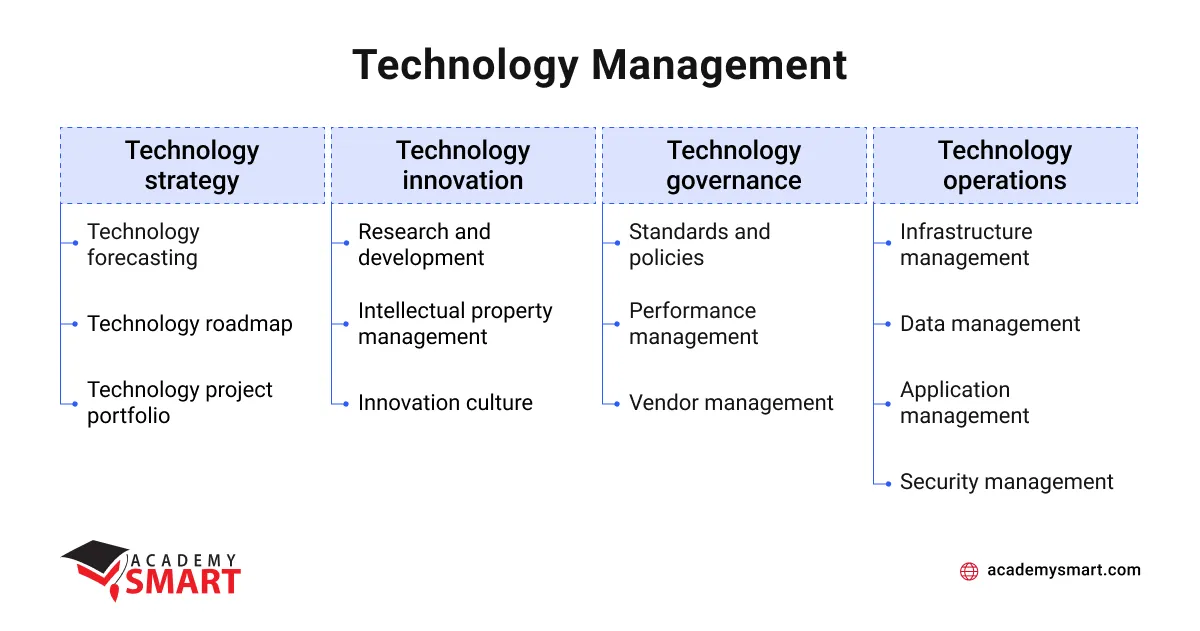
Technology management is vital to any organization, as it effectively manages technology resources and their strategic use in the long term. It has a complex structure of various components, each playing a crucial role in the success of a company’s technology initiatives.
1. Technology strategy
Technology strategy refers to a set of plans, decisions, and actions to manage its technology resources and align them with its objectives. It should support the overall business strategy and provide a roadmap for technology-related decisions and investments. It involves assessing the current state of technology, identifying gaps and opportunities, and formulating a plan to acquire, develop, deploy, and manage technology resources to create competitive advantage and value for the organization.
Technology forecasting
Technology forecasting is a process of predicting future technology trends and developments. It involves analyzing data, identifying patterns, and predicting technology in a particular industry or field. This information can be used to guide decision-making and inform strategic planning for organizations looking to stay ahead of the curve in terms of technological innovation. It can help enterprises identify emerging trends, anticipate disruptions, and remain competitive in a rapidly evolving technological landscape.
Technology forecasting is essential in choosing a tech stack for a software development project. It involves analyzing existing and emerging technologies, evaluating their potential impact on the organization, and deciding which technologies to adopt for future projects. This decision-making process can consider cost, compatibility with existing IT systems, scalability, security, and performance.
Technology roadmap
The overall strategic vision of the company’s technological development is usually embodied in a technology roadmap. Such a roadmap is a strategic plan that outlines how a company plans to implement and adopt new technologies over a specified period. It helps organizations prioritize and plan technology initiatives, allocate resources and budget, and ensure alignment with strategic aims. A technology roadmap typically includes specific technology projects, timelines, budgets, and performance measures and can span several years into the future.

Project roadmap template
Elevate your projects with our roadmap template. Perfect for creating a technology roadmap that is strategically planned, well-organized, and on track for success.
Technology project portfolio
Another significant part of the technology strategy is a technology project portfolio, which refers to collecting an organization’s ongoing and planned technology projects. The portfolio usually overviews each project’s scope, timeline, resources, and goals. It includes a list of all the tasks the organization is currently undertaking and the ones planned for the future, and also budgets, risks, and benefits. Enterprises can prioritize and allocate resources effectively by maintaining a portfolio of technology projects and ensuring that the projects align with the company’s overall technology strategy.
2. Technology Governance
Technology governance refers to the policies, procedures, and decision-making processes that ensure a company’s technology is managed, aligned with its plans and objectives, and compliant with relevant regulations and standards. It is the framework that guides technology management and helps to ensure that its object is used in a way that is consistent with the organization’s values and strategic plans.
Technology governance is critical because it provides a foundation for developing and implementing technology strategy. By establishing transparent governance processes and decision-making structures, organizations can ensure that technology investments are aligned with current goals, risks are managed effectively, and resources are allocated efficiently. Without governance, technology decisions may be fragmented and uncoordinated, leading to duplication of effort, wasted resources, and potential security and compliance risks.
Standards and policies
Standards and policies are the set of rules and guidelines that govern the use and management of technology within a company. These policies define the standards, best practices, and procedures for technology use and management, including security, data management, privacy, compliance, and risk management. These policies help ensure that technology is used consistently, securely, and efficiently and that the organization complies with relevant laws and regulations.
Performance management
Performance management measures and evaluates the performance of technology resources, assets, and services in alignment with the organization’s objectives. It involves establishing metrics, monitoring performance, identifying areas of improvement, and implementing changes to optimize performance. It can include evaluating IT processes’ efficiency, assessing IT service delivery’s effectiveness, and monitoring technology investments’ performance. Performance management helps ensure that technology resources are utilized efficiently, and in a way that supports the organization’s strategic needs.
Vendor Management
Vendor management manages relationships with third-party companies who provide technology-related products or services to an organization. It includes identifying potential vendors, negotiating contracts, monitoring their performance, and ensuring providers comply with established standards and policies. Effective vendor management ensures that technology solutions meet an enterprise’s needs, are delivered on time and within budget, and are supported well over time.
3. Technology operations
Technology operations encompasses the day-to-day activities involved in managing and maintaining an organization’s technology infrastructure. It ensures that technology systems function correctly and efficiently, providing technical support to users, managing data centers, and overseeing the organization’s network security. Technology operations also include operating hardware and software upgrades, performing backups, and disaster recovery planning.
Infrastructure management
Infrastructure management is managing the underlying hardware and software infrastructure supporting an organization’s technology services. It involves planning, designing, implementing, and maintaining the physical and virtual technology infrastructure components such as servers, storage, clouds, network devices, databases, operating systems, and other related software. Infrastructure management aims to ensure the technology infrastructure’s optimal performance, availability, scalability, and security to meet the needs of all business operations.
Data management
Data management refers to the set of processes, policies, and procedures governing the creation, storage, and disposal of an organization’s data assets. It involves managing data from various sources, ensuring data quality and consistency, protecting data privacy and security, and making data available to users when and where they need it.
Application management
Application management is the processes and activities involved in managing the various software applications used in an organization. It includes installation, maintenance, troubleshooting, upgrades, and support for the applications throughout their lifecycle. Effective application management helps to improve productivity, reduce costs, and increase the value of technology investments.
Security management
Security management protects and secures an organization’s technology assets, including hardware, software, and data, from potential threats and vulnerabilities. It involves designing, implementing, and maintaining security measures such as firewalls, intrusion detection and prevention systems, access controls, and encryption to safeguard against cyber-attacks, data breaches, and other security risks. Security management is critical for ensuring the confidentiality, integrity, and availability of a company’s technology infrastructure and assets.
4. Technology innovation
Technology innovation is the most exciting component of technology management, which is critical for enterprises to stay competitive in today’s rapidly changing digital world. It refers to the processes and activities involved in identifying, developing, and implementing new and innovative ways to create additional value for the enterprise. It helps rationalize the process of developing new software products and services with increased customer satisfaction using technology to gather customer feedback and insights, optimize product development processes, and ensure that new products and services meet or exceed customer expectations. It usually includes exploring emerging technologies, conducting research and development, and experimenting with new approaches and techniques to solve current business problems or create new opportunities.
Research and development
Research and development (R&D) are key activities in technology management that aim to create new opportunities for growth and competitive advantage. They involve conducting systematic investigation, experimentation, and analysis to gain new knowledge, develop new technologies, or improve existing ones. R&D includes exploring emerging technologies, conducting feasibility studies, prototyping, and testing new products or services.
Intellectual property management
Intellectual property management protects a company’s intellectual property, including patents, trademarks, copyrights, and trade secrets. It is essential in technology innovation to safeguard the company’s inventions, software, and other proprietary technologies. That involves conducting patent searches, filing patents and trademarks, licensing technology, and protecting the company’s intellectual property rights. By managing intellectual property effectively, a company can safely keep its innovations and gain a competitive advantage in the market.
Innovation culture
An innovation culture helps organizations stay leading by continuously generating new ideas, products, and services that meet customer needs and improve business processes. It encourages innovative intention within a company and includes creating an environment that supports and rewards experimentation, risk-taking, and creative problem-solving.
Why is Technology Management important
As you can see, the company’s technology management team’s responsibilities are comprehensive, although they may vary depending on the type of enterprise and its size. In general, technology management helps to solve the following important tasks:
- Form a strategic program for the company’s technological development identifying and prioritizing investments in technology, and developing a roadmap for implementing and integrating technology solutions;
- Optimize expenses for technological equipment of the company and development of innovative solutions by assessing current technology infrastructure, identifying areas for improvement or potential cost savings, and implementing new and emerging technologies to drive innovation and growth;
- Improve the operational efficiency of the enterprise and its employees by using technology to streamline and automate business processes, optimize workflows, and increase productivity;
- Create competitive advantages by the higher organization of processes and added value of products leveraging technology to differentiate products and services from competitors, providing unique value to customers, and improving overall customer experience;
- Choose the best technology stack as a basis for a software product’s successful development and subsequent deployment;
- Manage interactions with contractors and third-party IT service providers to establish productive and profitable collaborations and replace unsuitable vendors with the best technology solutions.
To understand why technology management is so important and may be helpful for your business, it is enough to assess your company’s current performance in the market. During this analysis, you will probably find weaknesses in the organization of processes, outdated technology solutions, or inefficient use of available IT resources. Many of our clients at this stage have decided to involve professionals to solve current challenges and achieve their strategic goals most effectively. Examples of our work are presented in a brief presentation below.
How to improve Technology Management
There are several well-tried ways how to improve technology management:
- Hire qualified technology managers
Having skilled and experienced professionals in technology management positions can significantly improve the effectiveness of the function. - Implement best practices
Adopting industry best practices for technology management can help organizations to optimize their operations and stay ahead of the competition. - Develop a culture of innovation
Encouraging a culture of innovation within the organization can help to drive technological advancements and improve the overall quality of products and services. - Foster collaboration
Promoting collaboration between technology management and other departments within the enterprise can lead to more effective decision-making and better alignment with business objectives. - Invest in training and development
Regular training and development opportunities for technology management personnel can keep them up-to-date with industry trends and best practices. - Monitor and measure performance
Regularly measuring and monitoring the technology management KPIs can help identify improvement areas and ensure that the procedure is aligned with the organization’s overall strategic objectives.
Of course, these methods work best in combination, united into a single strategy for managing your technology potential. Practice shows that the success of our client’s software products on the market is directly related to the effectiveness of the technology management processes we help them establish by providing our development services.

working for us, and that felt great.”

How Academy SMART can help you
As our team builds custom software and supports our customers’ applications, we’re here to help you assess, upgrade, and evolve your technology infrastructure. The development of software products with our participation is a highly organized process managed by experienced technical specialists and responsible project managers. You also have access to strong outstaff programmers whose expertise can enhance the capabilities of your internal development team and optimize its work.
With our help, you are guaranteed to set up the processes for managing your technology resources and simplify the road to achieving planned results. Contact us, and you will find mutually beneficial cooperation for the long term.
Technology Management: Frequently Asked Questions
What field is Technology Management?
Technology management is a field of study and practice that combines management principles with technology-related knowledge and expertise. It focuses on planning, developing, implementing, and using technology to improve business operations and achieve strategic objectives.
What are the key concepts of Technology Management?
The key concepts of technology management include technology strategy, governance, operations, and innovation. These concepts help organizations manage their technology resources effectively to achieve their goals and remain competitive in their industries

Let’s build the LMS your
business actually needs
Book a free consultation and we’ll
recommend the right approach.