



8 Best White Label LMS Platforms for B2B Enterprises to Check Out in 2026

“Is there an LMS that can look and work like it’s my product?”
White label, most people say. But depending on who you ask, that means anything from swapping a logo to full vendor invisibility with a different domain and admin environment. Those are not the same thing, and confusing the two is how B2B enterprises end up locked into a platform that doesn’t solve their needs.
This article covers eight platforms worth evaluating if you’re building or scaling a B2B training business.
TL;DR
8 white-label LMS platforms for B2B
We grouped white-label LMSs into three categories: SaaS LMS with white-label options, a pre-built LMS you license once, and open-source platforms.

best for large enterprises training customers, partners, or dealers alongside internal staff. 3,500+ customers, 700+ G2 reviews.

best for mid-market training businesses wanting proven multi-portal infrastructure. 4.5 on G2, 250+ reviews.

best for small to mid-size training businesses selling professional development or certifications. Purpose-built for training companies.

best for training companies running structured cohort-based programs. Open edX-based, newer to market.

best for knowledge businesses making their first move into B2B sales. 4.5 on G2, 400+ reviews.

best for training businesses that want to own their LMS outright without a fully custom build. $17K one-time, live in 4–6 weeks.

best for technically resourced providers wanting open-source infrastructure. 148,000+ active sites.

best for technically ambitious providers building at significant scale. Powers Microsoft Learn, edX, IBM Skills Network.
Seven questions to ask any white-label LMS vendor
Most LMS call themselves “white-label”, but few mean the same thing by it. Here are the questions worth asking before you evaluate any platform.
Architecture
Can I manage 50 clients, each isolated, from one dashboard?

Branding
Will my clients ever see the vendor’s name – anywhere

Pricing
Will my platform cost more every time I sign a new client?

Integrations
Will this connect to my CRM, HR system, and payment gateway?

Administration
Can each client manage their own users without involving me?

Ecommerce
Can I sell course licenses – bulk orders, invoicing, subscriptions?

Scalability
If I sign a Fortune 500 client tomorrow with 10,000 users, will the platform hold up?

- About architecture
Can I manage 50 different clients, each with their own branding, users, and data, from one dashboard, without them ever seeing each other?
Why: This is the difference between a white-label feature and architecture. True multi-tenancy means each client gets a fully isolated environment, with its own domain, users, and course catalog managed centrally by you. - About branding
Will my clients ever see the vendor’s name: in the platform, in automated emails, in the browser tab, anywhere?
Why: Superficial white-labeling means your logo replaces theirs. Structural one means the vendor’s name doesn’t appear anywhere, not in system emails, metadata, or support tickets. - About pricing
Will my platform cost more every time I sign a new client?
Why: Per-seat pricing is a tax on your own growth. Every new client you sign costs you more to serve. A predictable pricing model (one-time license or usage-based on active users rather than total seats) lets you price your own product confidently. - About integrations
Will this connect to my CRM, HR system, and payment gateway, or will I be managing everything manually?
Why: Enterprise clients will require SSO/SAML. Your sales team will want LMS data in Salesforce. Your courses need SCORM/xAPI support to run and report correctly. API access determines how far you can extend the platform beyond its out-of-the-box integrations. - About administration
Can each of my clients manage their own users independently, without us becoming their IT department?
Why: Client self-administration means each corporate client can add users, assign courses, and pull their own reports without seeing other clients or your master settings. Without it, every new client you onboard adds to your admin overhead permanently. - About ecommerce
Can I sell course licenses to corporate clients directly through the platform, with bulk orders, invoicing, subscriptions?
Why: The platform needs to handle group license purchases, automated enrollment, invoicing, and subscription management. - About scalability
If I sign a large enterprise client tomorrow with 10,000 users, will the platform hold up?
Why: This will show whether “scalable” is a feature or a marketing claim. It’s harder to validate, so ask vendors directly how they handle concurrent users at peak load, and if they can share examples.
How we built this list of white-label LMS for B2B enterprises
Most “best white-label LMS” articles list platforms where white-labeling means changing a logo and a color scheme. We were looking for something more specific.
We set out to find LMS platforms that can support a B2B business, one that sells or delivers learning to other organizations, manages multiple client environments, and needs the platform invisible to end users.
Selection criteria: white-labeling beyond logo and CSS, some form of multi-client management, and independent reviews or documented deployments to write about honestly.
What didn’t make the list and why:
General SaaS platforms
built for SMBs like TalentLMS, LearnWorlds, and such. They have multi-tenant features on their pro tiers, but aren’t built for enterprises managing dozens of unrelated corporate clients
Enterprise LMS SaaS for internal L&D
like Absorb LMS. It has branded portals and solid enterprise credentials, but its entire documented user base is mostly L&D professionals training their own staff, with no evidence of commercial B2B training delivery at scale.
DIY workarounds
like WordPress with LMS plugins (LearnDash). It comes up frequently in similar articles but doesn’t provide multi-tenant architecture out of the box.
- On pricing: we used public pricing where available and flagged third-party estimates. But be sure to always verify directly with the vendor.
- On reviews: we looked into G2 and Capterra ratings and quotes, supplemented by Reddit and other community forums threads.
- On Academy Smart: we’re on this list, too. Academy Smart LMS is our product, and it’s part of why we wrote this article. We wanted to be honest about where it fits and where it doesn’t, alongside every other platform here.
Disclaimer: All info is current as of June, 2026.
SaaS LMS with white-label options
SaaS LMS is where most companies start. These are established platforms with white-label features built in to varying degrees. What separates them is how deep the white-labeling goes, how multi-tenancy works, and what the pricing model does to your margins as you grow.
With that in mind, let’s look at the solutions.
Docebo
Best for: large enterprises that train customers, partners, or dealers on their own products and need to manage those external audiences alongside internal staff from one platform.
- Around since: 2005
- Pricing: Per-learner, per-module subscription. 1–3 year contracts, no public pricing.
- Key integrations: Salesforce, Microsoft Teams, Google Analytics, SSO/SAML, Workday, BambooHR, Zoom, Slack. API-based
- Target market: North America, Europe
- G2 rating: 4.3 (700+ reviews)
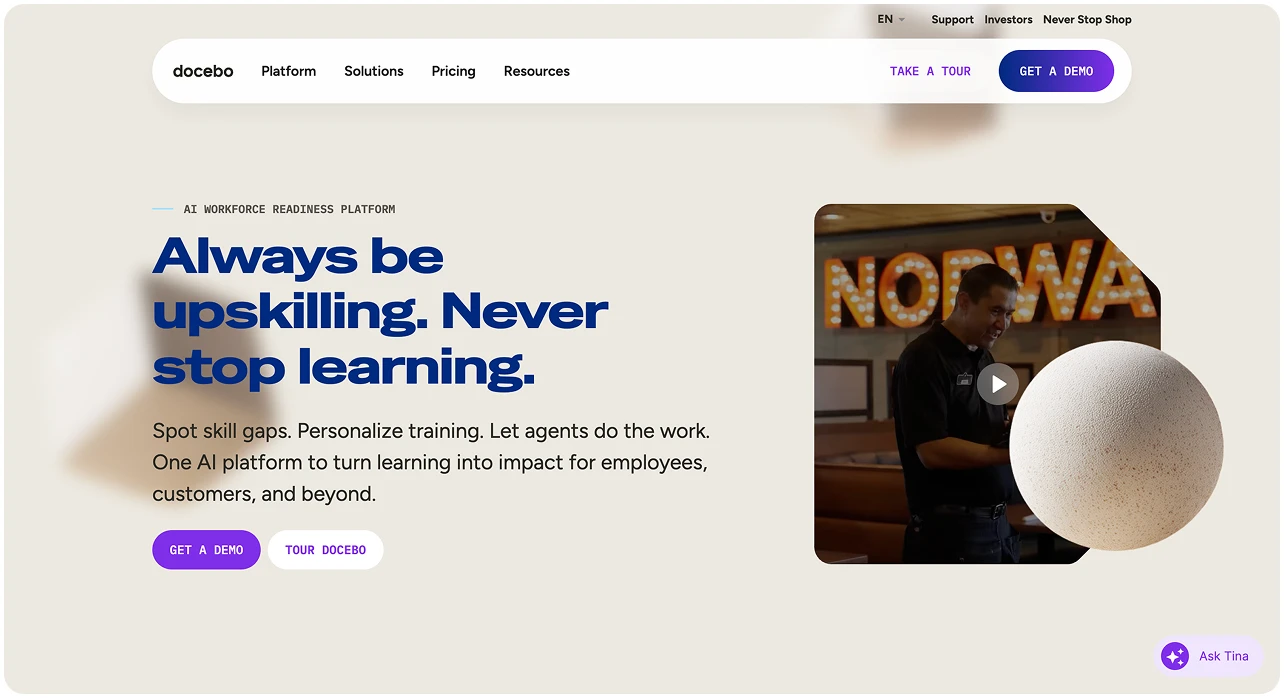
With 3,500+ customers, 700+ G2 reviews, and operations in 60 countries, Docebo is one of the most widely deployed enterprise LMS platforms available. It’s used by technology, manufacturing, and professional services enterprises, with Google, HP, L’Oréal, Heineken among them. That scale makes it frequently the first name in enterprise LMS lists by default.
If you’re running learning as a business (selling to corporate clients, managing separate portals per customer), three Docebo features are worth knowing about:
- Extended Enterprise lets you create separately branded learning environments, each with its own URL, branding, catalog, and SSO, for different client groups, managed from one root platform.
- The Ecommerce module lets you sell training content commercially.
- Multi-domain support means each client portal can have a fully independent URL.
There’s a caveat, though. Scroll through Docebo’s reviews and the overwhelming majority are from HR Advisors, L&D Managers, and LMS Administrators at mid-to-large enterprises training their own staff. This tells us Docebo’s primary identity is a corporate learning platform.
The consistent positives are the admin UI, the Docebo Community for peer troubleshooting, and the ease of creating and uploading courses. For external training use cases specifically, Cindy, a Product Support Specialist at an automotive company, captures what’s possible: “We have 3 different homepages set up for different companies we work with, which makes them feel like the platform was created just for them.”
Limitations: Meaningful customization beyond logo and colors requires custom CSS. One practitioner who inherited a Docebo instance touched by three previous developers described it as “messing with a house of cards.” SCORM bookmarking issues come up repeatedly. Per-learner billing means every new client you sign costs you more to serve.
Bottom line: Docebo fits if you’re a large enterprise using training to support a core product — certifying external implementers, training a dealer network — with a developer on hand. If training is your standalone business, per-learner pricing and developer-dependent customization both work against your margins as you scale.у
LearnUpon
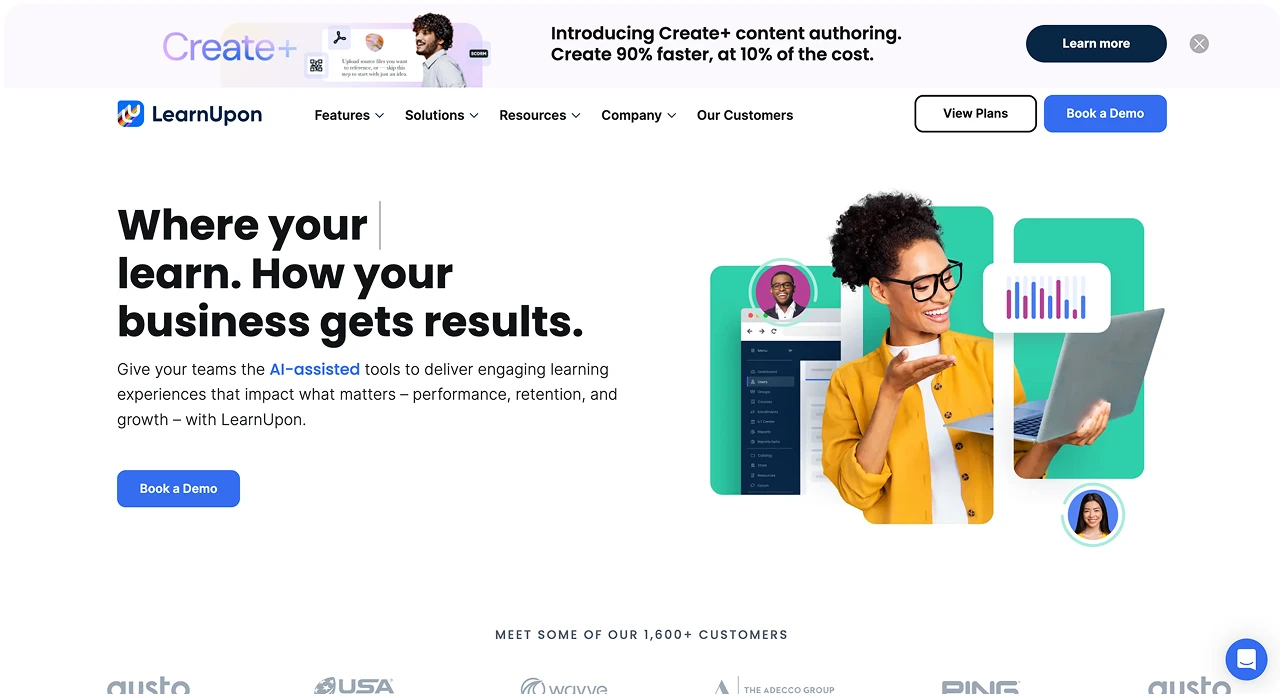
Best for: mid-market training businesses that want a well-supported multi-portal LMS.
- Around since: 2012
- Pricing: Monthly Active User subscription. White-labeling and multi-portal from Premium tier upward. No public pricing; estimated to start at $60,000/year.
- Key integrations: Salesforce, BambooHR, ADP, Workday, SSO/SAML, Zoom, Slack, REST API.
- Target market: North America, Europe, global
- G2 rating: 4.5 (250+ reviews); Capterra: 4.7 (130+ reviews)
If Docebo is the enterprise giant, LearnUpon is the Salesforce of the LMS world. It’s so widely adopted that an entire ecosystem of integrations, partners, and custom development has grown around it. Academy Smart, for one, is part of that ecosystem as a certified LearnUpon partner. This means, when LearnUpon customers need something the platform won’t build natively, we build it for them. Teachers of Tomorrow is one example.
For B2B companies specifically, the Portals feature is what makes LearnUpon worth considering. Each portal runs its own branding, domain, course catalog, SSO, and user access rules, with all managed from one account. One Software Advice reviewer describes using it for exactly this: “…setting up multiple white-labeled portals for onboarding and training of multiple software products.” Pricing runs on Monthly Active Users rather than total registered users.
Across 300+ reviews on G2 and Capterra, two things come up consistently: exceptional support and ease of use. Customer Success Managers are mentioned by name more than in any other LMS on this list.
Limitations: The native authoring tool is basic — text, images, video, no interactive features. Most teams import content from a separate authoring tool. Reporting depth improves at Enterprise but feels limited at Premium. And if your use case is non-standard, you’ll hit walls the platform wasn’t designed to handle.
Bottom line: LearnUpon fits if you want a proven, well-supported multi-portal LMS without enterprise complexity. The more custom your requirements are, the more you’ll need a development partner to extend it.
Academy of Mine
Best for: small to mid-size training businesses selling professional development, certifications, or continuing education.
- Around since: 2014
- Pricing: From $999/month (Professional). Enterprise: custom pricing, unlimited users and customizations
- Key integrations: Salesforce, HubSpot, Stripe, PayPal, Authorize.net, Microsoft Teams, Zoom, QuickBooks, Google Analytics, SSO/SAML (Azure AD, OAuth, SAML 2.0)
- Target market: Primarily North America
- Capterra rating: 4.9 (45 reviews)
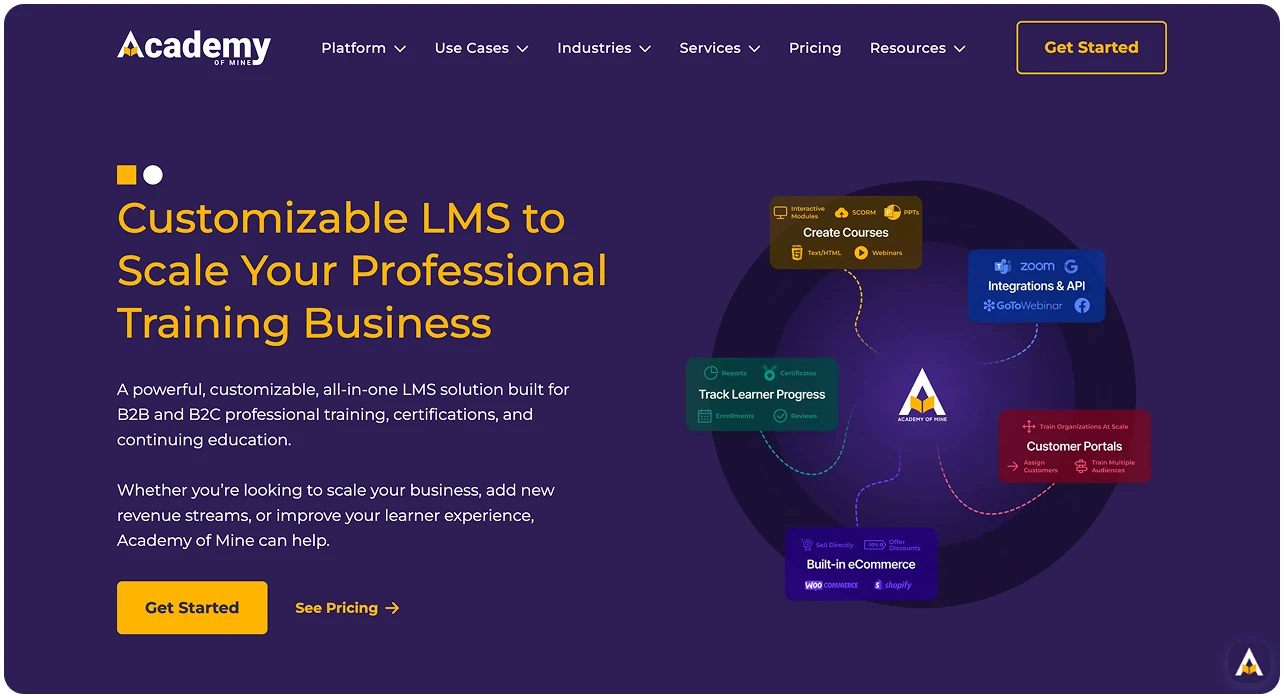
Academy of Mine is purpose-built for training companies. Their own description of the ideal customer reads “smaller to mid-size companies looking for a B2B-focused training platform for professional training and certifications.”
The two features that matter most here are B2B Portals and eCommerce. Portals let you onboard clients and train them in separate environments; each group sees only their own content, courses, and users. The eCommerce module handles course sales, subscriptions, and bulk license purchasing without needing a third-party tool. Both come on the Professional plan.
The Enterprise tier adds unlimited users and unlimited custom development. “You ask, we build” is how they put it.
Support is the standout, mentioned by name across reviews more than any other feature. Reviewers consistently describe the team as genuinely invested in helping them build their training business.
Limitations: 8 in 10 of reviewers on Capterra are SMBs. If you’re managing 50+ client portals at enterprise scale, Academy of Mine hasn’t been widely validated at that level. Initial setup has a learning curve: customization menus aren’t always intuitive, and some features that feel standard elsewhere are more basic here. Pricing starts at $999/month which some smaller training businesses flag as steep before they’ve scaled.
Bottom line: Academy of Mine fits training companies at the growth stage. We’re talking established enough to need real multi-portal infrastructure, but not yet at the scale where enterprise SaaS pricing becomes the constraint. If you’ve outgrown a basic LMS and need something that bends to your workflow without a full custom build, it’s worth a look.
Blend-ed
Best for: training companies and professional academies that run structured cohort-based programs, certifications, and instructor-led training.
- Around since: 2020
- Pricing: Custom; tailored to learner scale, usage, and features. Free trial available on request.
- Key integrations: Payments, analytics, communication, and knowledge management tools including regional payment systems and tools like Notion
- Target market: Middle East, North Africa, North America
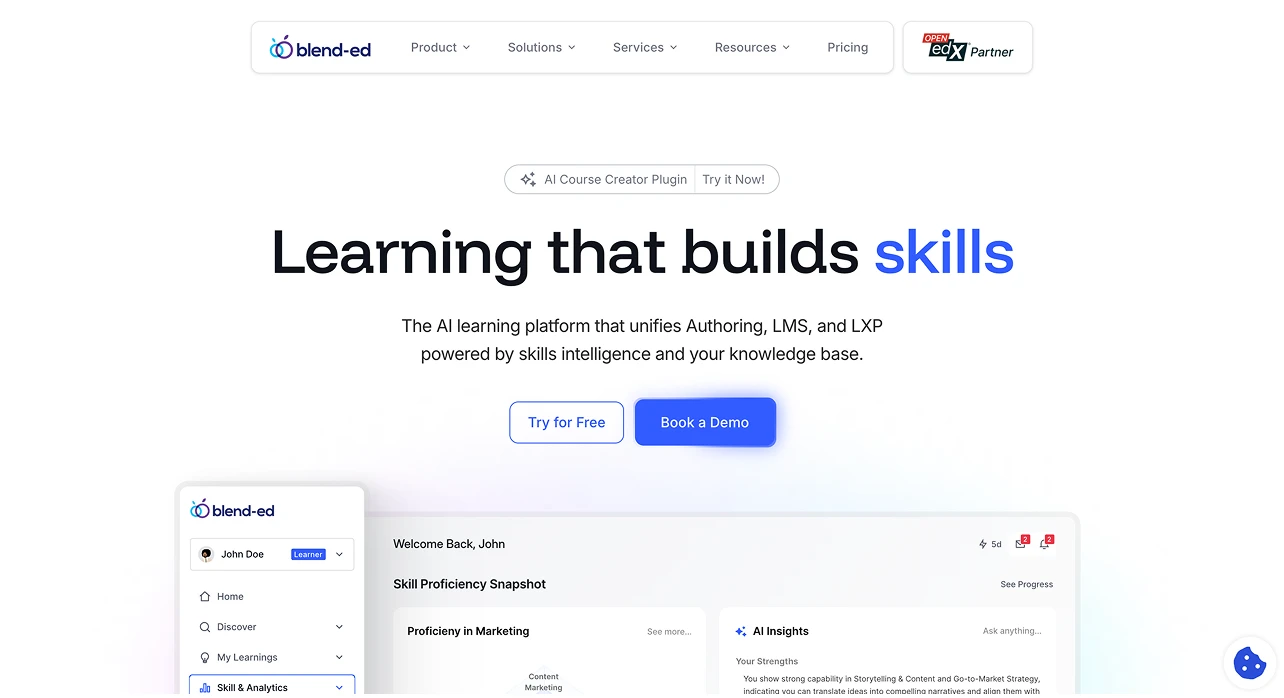
One of the newer platforms on this list, Blend-ed is worth including because it’s built differently from the others. Its foundation is Open edX, the open-source platform developed by MIT and Harvard that now powers Microsoft Learn and edX. Building on Open edX means inherited tested infrastructure and native SCORM/xAPI support. The tradeoff: for the core engine, they’re on the Open edX roadmap.
Blend-ed is designed for training companies that run structured programs (cohorts, instructor-led sessions, certifications). From one dashboard you can schedule cohorts, assign trainers, track attendance, auto-generate branded certificates, and manage multiple client environments under separate branding and domains.
In the meantime, independent reviews are thin, with only two verified on major platforms at time of writing. The one published customer quote speaks to the “smooth” migration experience that “delivered a far more stable platform that’s ready for future upgrades.” It’s a useful signal, but if you’re seriously evaluating Blend-ed, request other references directly.
Limitations: Geographic focus skews toward the Middle East and North Africa, so if you’re based in the UK or EU, check whether their support and infrastructure setup matches your requirements before committing. Pricing is custom with no public tiers.
Bottom line: Blend-ed is an interesting option for training companies running structured, cohort-based programs who are comfortable evaluating a newer platform with limited public track record. It’s worth a demo, with your eyes open on the review gap.
Thinkific Plus
Best for: training companies and professional academies that run structured cohort-based programs, certifications, and instructor-led training.
- Around since: 2012
- Pricing: Custom, estimated to start at $3,500/month. Branded mobile app for $199/month.
- Key integrations: HubSpot, QuickBooks, SSO/SAML, API access, Zapier, Mailchimp
- Target market: North America, global
- G2 rating: 4.5 (400+ reviews)
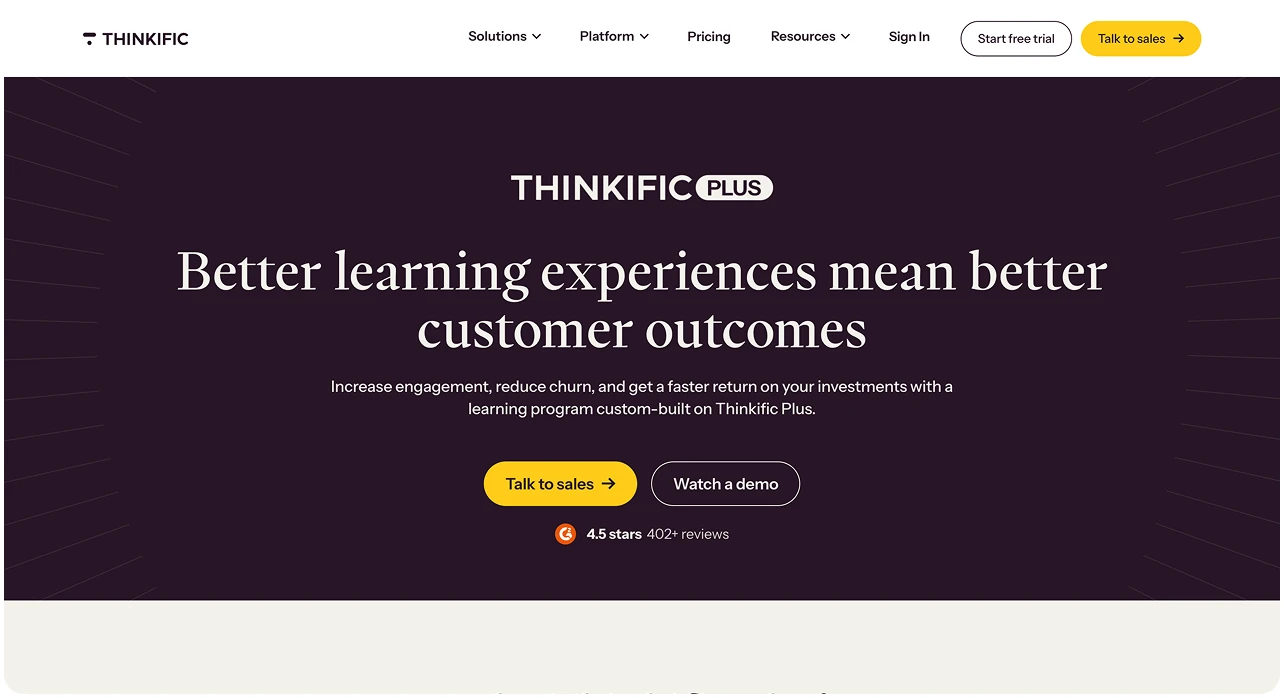
Thinkific started as a course creation platform for knowledge entrepreneurs — coaches, consultants, subject matter experts selling courses online. Thinkific Plus is their enterprise tier where B2B features live.
On Plus, you get custom domain, branded experience, SSO, SCORM compliance, API access, and a dedicated customer success manager. On the multi-tenancy side, each client gets their own separate Thinkific site, with its own domain, branding, and user base. Client data is isolated. As for the commerce tools, the platform offers bulk selling via group orders, payment processing, and automated enrollment.
Reviews consistently praise the course creation tools and commerce features. The platform is genuinely easy to use for building and selling learning content.
Limitations: Managing multiple corporate clients means separate Thinkific sites rather than a single multi-tenant platform. The Plus Portal lets you switch between them without logging in and out, but course updates need replicating across sites manually and there’s no cross-environment reporting. The more clients you add, the more administrative overhead that creates.
Bottom line: Thinkific Plus fits if you’re a knowledge business or growing course creator making your first serious move into B2B sales — selling training programs to companies in bulk, running customer education, or building a partner certification program. If multi-tenant architecture is a core requirement from the start, the other platforms in this category handle it more natively.
Pre-built white-label LMS you license once
Most companies start with SaaS, and it works like a charm for some time. But when your client base grows, per-seat pricing starts working against your margins. A pre-built licensed LMS breaks that model: you pay once and scale without the per-user tax.
Academy Smart
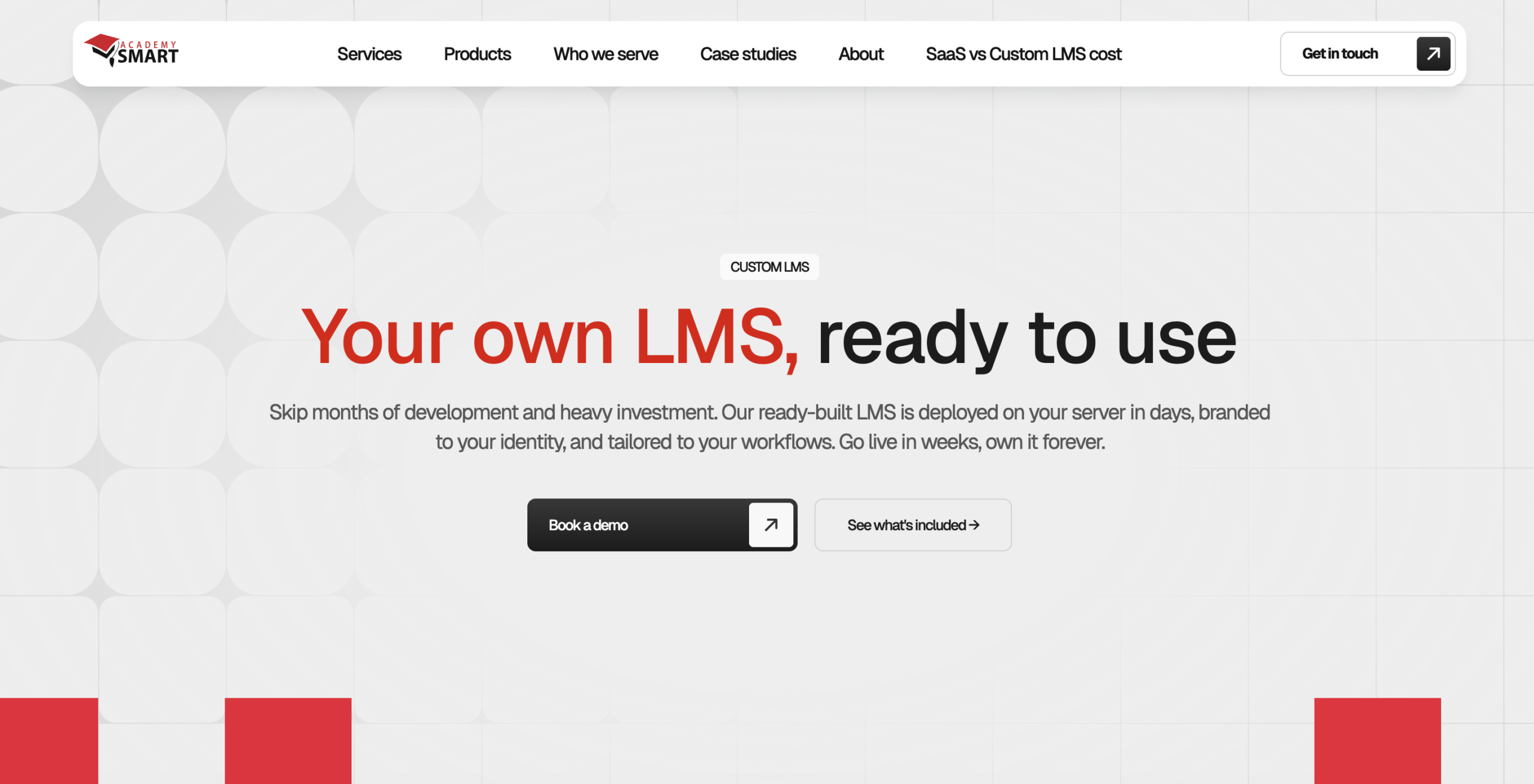
Best for: B2B companies that have outgrown SaaS pricing and need a fully white-labeled, multi-tenant platform without the timeline and cost of a custom build from scratch.
- Around since: 2009
- Pricing: $17K, one-time license. Optional monthly support retainer.
- Key integrations: Salesforce, BambooHR, Workday, SSO/SAML, SCORM/xAPI/AICC, REST API.
- Delivery: 4-6 weeks
- Target market: USA, UK, EU
- Clutch rating: 4.9
We’ve been building LMS solutions since 2009. Academy Smart LMS is our experience packed into a ready-to-deploy product. It’s 80% pre-built, 20% customized, and goes live in 4 to 6 weeks.
It’s built on the same architecture we use for B2B companies at scale. Take Cyber Inc., a security awareness training provider. They needed 86 separate branded client environments across 27 languages, with no vendor footprint visible to any of their corporate clients. Per-seat pricing would have made the model unworkable. We built that infrastructure for them at 68% lower cost than a SaaS alternative.
The Smart LMS puts that same foundation in your hands in 4 weeks.
What you get out of the box: multi-tenant architecture, full white-label and custom domain per client, SSO, SCORM/xAPI/AICC, role-based access, and central reporting across all client environments. The LMS is hosted on your infrastructure with no per-seat fees.
Limitations: The Smart LMS is a pre-built foundation. If your requirements are highly specific from day one, the 20% customization scope may not cover everything. In that case, we also build fully custom LMS platforms from scratch, but that’s a different conversation to have. Also, as it’s a self-hosted platform, someone needs to manage your infrastructure, either your own team or via our optional support retainer.
Bottom line: The Smart LMS fits if you need real multi-tenant, white-label infrastructure and want to own it outright. At $17,000 one-time versus $15–30K per year on enterprise SaaS, it typically pays for itself within the first year.

Multiple clients
Run multiple organizations on one platform, each fully branded.

Custom branding
Your logo, your colors, your domain. Every client sees your brand, not ours.

Learning path builder
Build training paths with dependencies, milestones, and auto certifications.

Role-based access control
Super Admin, Owner, Admin, Manager, Trainee. Each role sees only what they need.

Unlimited users
No per-seat pricing. Onboard 100 users or 10,000 — your license cost doesn’t move.

100% compliance
Full SCORM, xAPI, and AICC support with complete learner tracking.

Role-specific dashboards
Admins, managers, and learners each get a separate dashboard.

Bulk user and course upload
Import users and assign courses in minutes using spreadsheets. No manual work.
Multiple clients
Run multiple organizations on one platform, each fully branded.
Custom branding
Your logo, your colors, your domain. Every client sees your brand, not ours.
Learning path builder
Build training paths with dependencies, milestones, and auto certifications.
Role-based access control
Super Admin, Owner, Admin, Manager, Trainee. Each role sees only what they need.
Unlimited users
No per-seat pricing. Onboard 100 users or 10,000 — your license cost doesn’t move.
100% compliance
Full SCORM, xAPI, and AICC support with complete learner tracking.
Role-specific dashboards
Admins, managers, and learners each get a separate dashboard.
Bulk user and course upload
Import users and assign courses in minutes using spreadsheets. No manual work.
Open-source white-label LMS
Finally, we have open-source LMS. Open-source nature means it’s genuinely white-label by default: there’s no vendor branding to remove because there’s no vendor. The following options are free to license and backed by large, active developer communities. The tradeoff: hosting, maintenance, developer time, and any commercial plugins or themes can become costly.
Moodle
Best for: training providers who want open-source infrastructure with a large developer ecosystem and plugin library behind them and are willing to manage hosting and maintenance themselves.
- Around since: 2002
- License: Free. You pay for hosting, maintenance, and customization
- Key integrations: plugin-based ecosystem, thousands of integrations available
- Active sites: 148,000+ across 241 countries
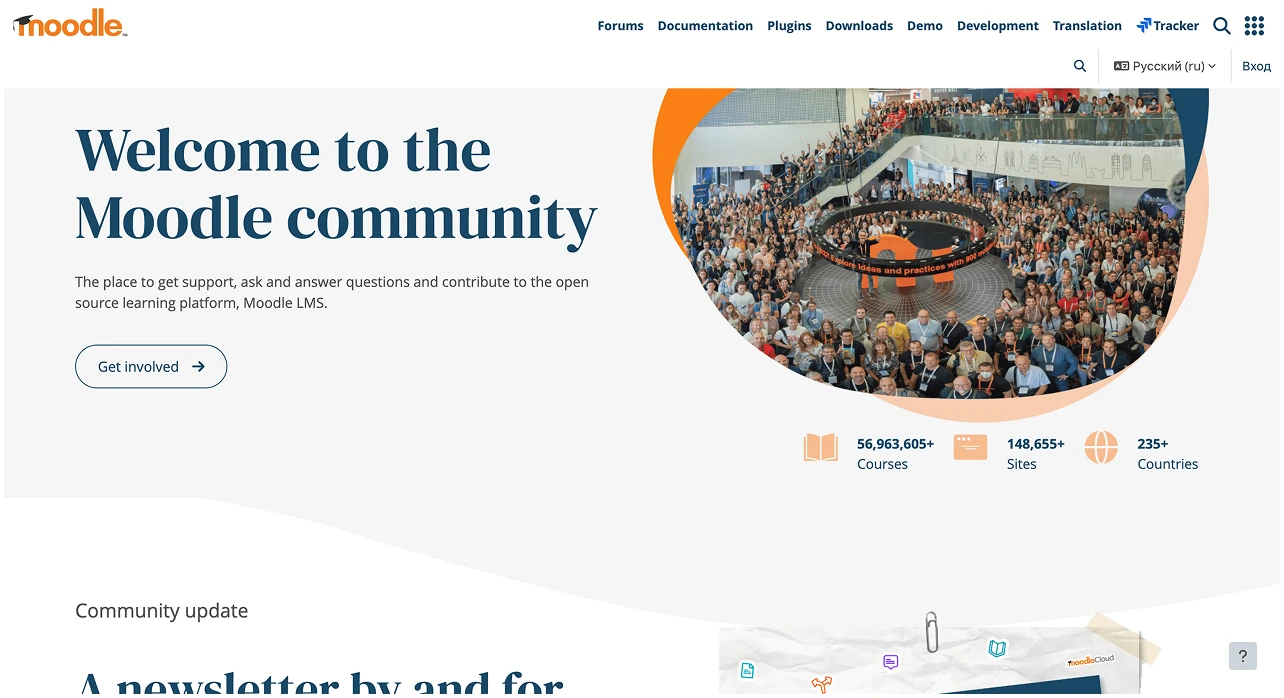
Moodle is the most widely deployed open-source LMS in the world, with 148,000+ active sites across universities, government agencies, and corporate training programs. It’s academic-heavy by nature, but commercial training companies use it at scale too. Cegos, one of Europe’s largest L&D providers, runs 55,000+ active learners on it.
For B2B multi-client delivery, there are two routes:
- Moodle Workplace: the commercial tier that adds multi-tenancy, automated workflows, and compliance reporting. Each tenant gets a fully isolated environment: separate branding, users, content, and data. Available through Moodle Certified Partners only.
- IOMAD: a free, open-source Moodle fork with multi-tenancy built in natively. Each company gets its own isolated space, course access rules, and reporting. Also includes licensing and ecommerce for selling courses commercially. Self-hosted.
Limitations: The default admin interface is what one reviewer called “archaic design and a stone-age dashboard.” White-label themes can make it look nothing like standard Moodle, but every customization, plugin or theme, adds to what you’ll need to maintain and debug when something breaks.
Bottom line: Moodle fits if you have technical resources in-house and want full infrastructure control. Without a developer on staff, the operational overhead will likely outweigh the cost savings.
Open edX
Best for: training providers who want open-source infrastructure with a large developer ecosystem and plugin library behind them and are willing to manage hosting and maintenance themselves.
- License: Free and open-source
- Maintained by: 2U (nonprofit)
- Key integrations: plugin-based ecosystem, thousands of integrations available
- Notable deployments: Microsoft Learn, edX, IBM Skills Network
Open edX is the platform behind some of the largest learning environments in the world, having edX, Microsoft Learn, IBM Skills Network among them. Originally built by MIT and Harvard, it’s now maintained by nonprofit 2U and used across higher education, government, and corporate training globally.
For B2B providers, the appeal is in no license fees, vendor roadmap, or per-seat costs.
Limitations: Multi-tenancy isn’t built in by default. It requires the eox-tenant plugin, developed by third-party provider eduNEXT, plus the developer resources to install and maintain it. The practical route for most companies is a managed Open edX provider who handles infrastructure, hosting, and multi-tenancy on your behalf. Blend-ed, covered earlier in this article, is one example.
Bottom line: Open edX is genuinely powerful, but it’s a platform, not a product. Without a technical team or a managed provider behind it, the complexity outweighs the benefits for most training businesses.
Recap: 8 white-label LMS platforms for B2B
Every platform on this list supports white-labeling in some form. What separates them is the depth and the commercial model underneath it. Here’s the full picture at a glance.
Let’s sum up:
| Platform | Best For | Pricing Model | Starting Price | Multi-Tenancy | White-Label Depth |
|---|---|---|---|---|---|
 | Large enterprises training customers, partners, or dealers alongside internal staff | Per-learner, per-module subscription | Custom, enterprise contracts | Native (Extended Enterprise) | Full |
 | Mid-market training businesses wanting proven multi-portal infrastructure | Monthly Active User subscription | ~$15,000/year (est.) | Native (Portals) | Full from Premium tier |
 | Small to mid-size training businesses selling professional development or certifications | Monthly subscription | $999/month | Native (B2B Portals) | Full |
 | Training companies running structured cohort-based programs and certifications | Custom | Custom | Native | Full |
 | Knowledge businesses making their first serious move into B2B sales | Monthly subscription | ~$3,500/month (est.) | Separate sites via Plus Portal | Full on Plus tier |
 | B2B training companies that have outgrown SaaS pricing and want owned infrastructure | One-time license | $17,000; Then optional support retainer | Native | Full |
 | Training providers with technical resources wanting open-source infrastructure | Free license | Free (hosting/dev extra) | Via Moodle Workplace or IOMAD | Full (no vendor to remove) |
 | Technically ambitious training providers building at significant scale | Free license | Free (hosting/dev extra) | Via eox-tenant plugin | Full (no vendor to remove) |
If you feel like your B2B business could benefit from owning its LMS, but a fully custom build isn’t on the table, we’re happy to talk through what you’re building. We’ll tell you if the Smart LMS fits, or if something else on this list would serve you better.
Own your LMS. Skip the custom build.
Academy Smart LMS is pre-built,
customized to your workflow, and live in 4 weeks.
Yours to keep.